Heat Pumps in Prince George BC: Costs, Rebates, and Reality
Heat Pumps in Prince George BC: The $10,000 Mistake You Need to Avoid
If you are buying a home in Prince George, BC, or looking to upgrade your current heating system, you’ve likely seen the glossy brochures for heat pump rebates. The provincial government is handing out thousands of dollars in incentives to encourage homeowners to make the switch. At the same time, BC Hydro is issuing alerts asking residents to conserve electricity due to low reservoir levels.
This contradiction is the first sign that the heat pump conversation in Northern BC is more complicated than a simple rebate check. For first-time buyers, young families, and people relocating to Prince George, the heating system in your home is the single biggest factor in your monthly cost of living. Today, we are breaking down the real physics, the real costs, and the real numbers that "they" aren't telling you before you buy.
1. Understanding the Physics of Climate Zone 7A
Prince George sits in Climate Zone 7A, one of the most demanding heating environments in Canada. To understand why this matters, you have to understand how a heat pump works. Unlike a furnace, a heat pump does not create heat. It moves heat. It uses a refrigerant cycle to pull ambient thermal energy from the outside air and transfer it into your home.
The efficiency of this process is measured by the Coefficient of Performance (COP). A COP of 3.0 means the system produces 3 units of heat for every 1 unit of electricity it consumes. While this 300% efficiency sounds incredible on paper, physics has a way of interfering when the temperature drops. As the outdoor air gets colder, there is exponentially less thermal energy available for the system to harvest.
In Prince George, our average January design temperature is minus 29 degrees Celsius, and it can frequently dip to minus 32. While "cold-climate" heat pumps are rated to operate at these temperatures, their performance degrades severely as they approach these thresholds. Real-world testing in British Columbia has confirmed that heating capacity drops significantly right when you need it most.
2. The Hidden Reality of the Defrost Cycle
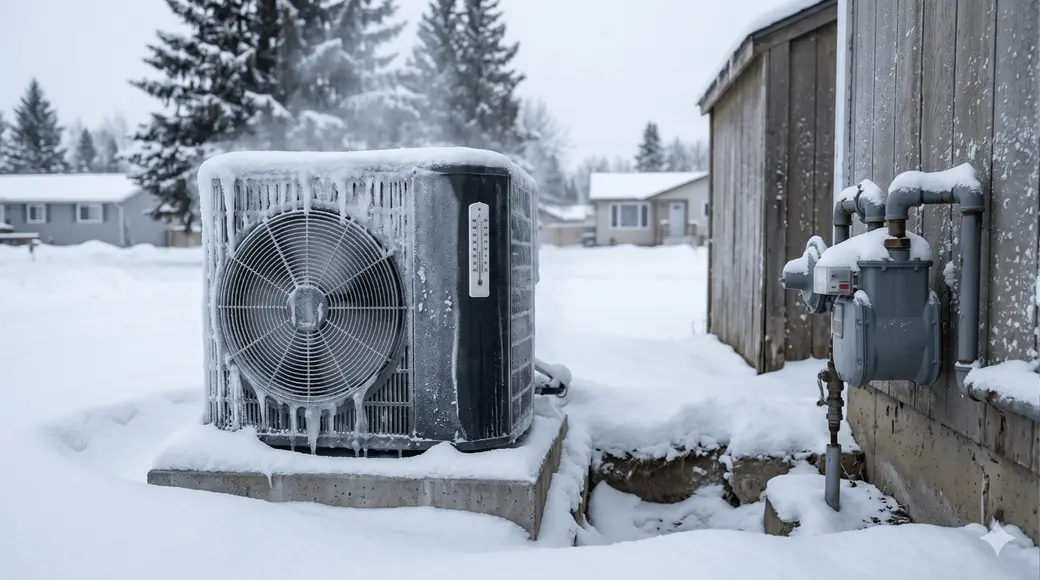
One of the most overlooked aspects of heat pump ownership in Northern BC is the defrost cycle. When temperatures drop below zero, moisture in the air condenses on the outdoor coils and freezes. To clear this ice, the heat pump temporarily reverses its operation, essentially running in air conditioning mode.
This means the system pulls heat out of your house to melt the ice off the outdoor unit. Modeling shows that for temperatures below 7 degrees Celsius, the average power draw of a heat pump increases by roughly 20% just to account for these cycles. You are paying for extra electricity to have heat pulled out of your home during a cold snap. This is a mechanical reality that rarely makes it into the marketing materials, but it is a major factor in your winter utility bills.
3. Why a Backup System is a Mechanical Necessity
In Prince George, a heat pump cannot be your only source of heat. It is not a standalone appliance in this climate. The standard, most reliable approach is a dual-fuel system: a cold-climate heat pump paired with a natural gas furnace as a backup.
In Climate Zone 7A, the "switchover point" is typically set at minus 13 degrees Celsius. Below that temperature, the heat pump shuts off and the gas furnace takes over entirely. This is practical because natural gas remains significantly cheaper than electricity for generating high-capacity heat in deep winter.
However, if your home doesn’t have a gas line, common in parts of the Hart, rural North Nechako, or Beaverly, and you rely on electric resistance heat as your backup, your costs during a prolonged cold snap can skyrocket to $2,500 a year or more. Knowing if your potential home has access to the FortisBC gas main is a critical step before making an offer.
4. The Financial Breakdown: Does the Math Work?
The capital cost to install a central cold-climate heat pump in Prince George typically ranges from $7,000 to $12,000. This doesn't include potential electrical panel upgrades or ductwork modifications. When you look at the operational savings, the results depend entirely on what system you are starting with.
If you are switching from an electric furnace or baseboards, a heat pump is a financial home run, often yielding over 50% in annual operational savings. But here is the "4% truth" for the majority of Prince George residents: If your home already has a natural gas furnace, switching to a heat pump as your primary source saves you approximately 4% per year on operational costs. On a $10,000 investment, a 4% annual saving takes a very long time to pay for itself.
5. Structural Requirements and Frost Heave
Finally, there is the physical installation. In Northern BC, you cannot simply set a heat pump on a floating concrete pad. Due to our frost depth requirements, any exterior pad supporting a heat pump must have anchor footings that go a minimum of 1.22 meters (four feet) below grade.
This prevents "frost heave" from shifting or toppling the unit during a hard winter. Proper installation requires excavation and formed concrete footings. If a contractor quotes you a price that doesn't account for this structural reality, they likely haven't performed an installation in a climate as demanding as ours.
Conclusion: Get the Facts Before the Rebate
Heat pumps are excellent technology, but they aren't a "one-size-fits-all" solution for Prince George. The decision to install one should be based on your home's current heating source, your access to natural gas, and an understanding of the mechanical limits of the system.
Navigating the Prince George real estate market and its unique infrastructure challenges doesn’t have to be stressful. Whether you are buying or selling, my goal is to ensure you are educated and empowered to make the best financial decision for your future.
Ready to find a home that's actually built for a Northern BC winter? Ask for my Home Buyers Program today for exclusive guides and step-by-step video walkthroughs of the process.
Categories
Recent Posts